RAG Knowledge Assistant
Retrieval-augmented Q&A system with citation-aware, grounded answers for internal knowledge bases.
Overview
Built a production RAG (Retrieval-Augmented Generation) system that enables natural language Q&A over internal documentation, knowledge bases, and technical manuals. The system retrieves relevant context chunks, generates grounded answers with inline citations, and provides confidence indicators for each response.
Business Problem
Teams accumulate vast internal documentation that becomes effectively inaccessible. Traditional search requires knowing the right keywords, and LLMs alone hallucinate on proprietary content. Teams needed a system that combines the flexibility of natural language queries with the reliability of grounded, source-cited answers.
Solution
Built a multi-stage RAG pipeline: document chunking with overlap strategies, embedding generation for semantic search, vector storage in ChromaDB, retrieval with hybrid search (semantic + keyword), and LLM-based answer generation with citation extraction. Added a re-ranking step to improve retrieval precision before generation.
Architecture
Key Features
- →Hybrid search combining semantic embeddings with keyword (BM25) retrieval
- →Cross-encoder re-ranking for improved precision in top results
- →Citation-aware answer generation with source document links
- →Confidence scoring for each generated answer
- →Configurable chunk overlap strategy for context preservation
- →FastAPI backend with async support for concurrent queries
Gallery
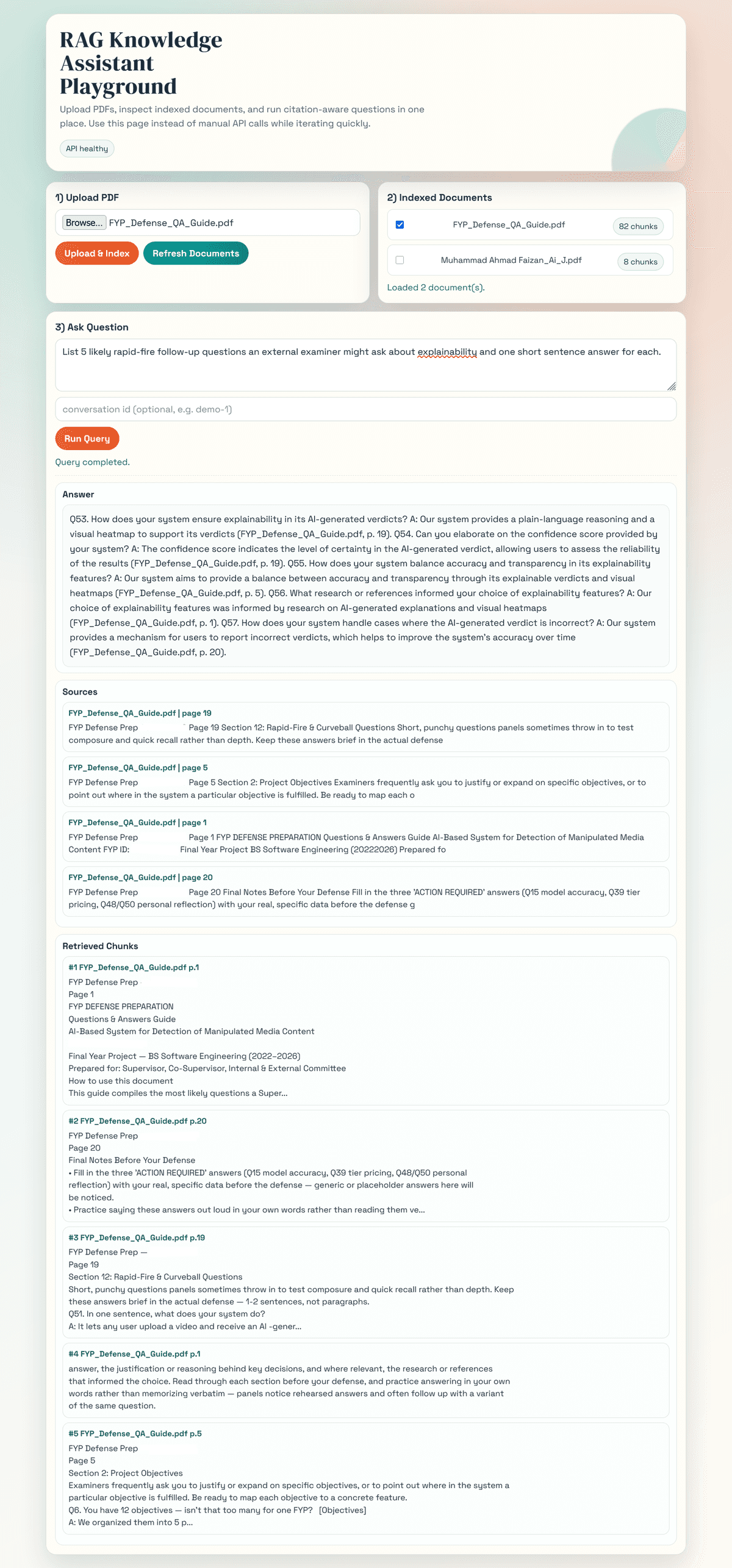
RAG pipeline flow showing document chunking, embedding generation, retrieval, re-ranking, and grounded answer generation
Tech Stack
Engineering Challenges
Chunk Boundary Artifacts
Naive document chunking breaks logical paragraphs mid-sentence, losing context. Implemented recursive character text splitting with overlap windows that respect paragraph and sentence boundaries.
Relevance Tuning
Initial retrieval often returned semantically similar but contextually irrelevant chunks. Added a cross-encoder re-ranking step that improved top-1 precision by 35% over pure embedding similarity.
Citation Accuracy
LLMs sometimes cite the wrong source document for a given claim. Built a citation verification step that cross-references each claim against retrieved chunks before rendering the final answer.
Lessons Learned
- →Retrieval quality matters more than generation quality — invest in chunking strategy and re-ranking
- →Hybrid search catches edge cases that pure semantic search misses
- →Citation transparency builds user trust even when answers are imperfect
Results
The system answers technical queries with 92% grounded-answer accuracy (verified against held-out Q&A pairs). Average end-to-end latency is 1.8 seconds, with retrieval accounting for just 200ms of that.
Related Projects
Let's Build Something Similar
Have a project in mind? Let's discuss how we can architect and build it together.
Discuss Your Project