AI Customer Support Agent
LLM-powered support agent with conversation memory, tool-use capabilities, and grounded responses.
Overview
Designed and built a production-grade AI customer support agent that handles inbound support queries with conversation memory, contextual understanding, and deterministic fallback chains. The agent integrates with internal knowledge bases via RAG, escalates to human agents when confidence is low, and maintains persistent conversation state across sessions.
Business Problem
Support teams at growing product companies face increasing ticket volumes. Traditional chatbots provide scripted, frustrating experiences. Large language models offer flexibility but introduce hallucination risk and lack business-specific context. The challenge was to build an agent that combines LLM fluency with grounded, reliable responses while preserving conversation history across sessions.
Solution
Built a multi-stage agent architecture using LangGraph for stateful workflow orchestration. The agent follows a structured pipeline: intent classification, knowledge retrieval via RAG, response generation with source citation, confidence scoring, and optional human escalation. Conversation memory is persisted in PostgreSQL with Redis caching for fast context retrieval.
Architecture
Key Features
- →Persistent conversation memory across sessions using PostgreSQL
- →Intent classification router using LangGraph for stateful orchestration
- →RAG-based knowledge retrieval with citation-aware responses
- →Confidence-based escalation to human agents
- →Tool-use capability for order lookup, status checks, and account actions
- →Redis caching layer for sub-200ms context retrieval
Gallery
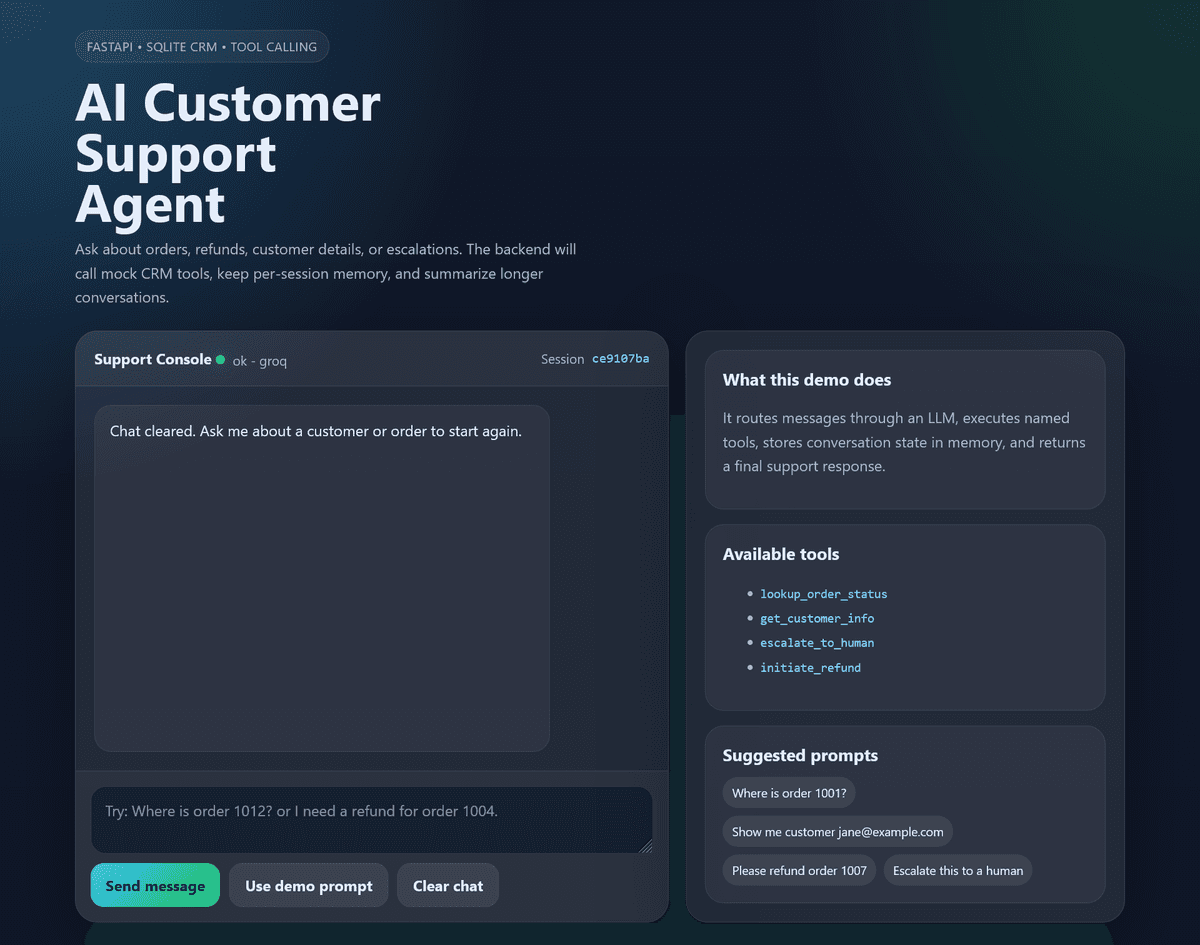
Agent conversation flow dashboard showing intent classification and response generation
Tech Stack
Engineering Challenges
Conversation Memory at Scale
Managing long-running conversations with thousands of turns required careful memory windowing. Implemented a sliding-window summarization strategy that compresses older turns into compressed summaries while keeping recent turns at full fidelity.
Hallucination Mitigation
LLMs confidently generate incorrect answers when context is ambiguous. Built a multi-stage confidence scoring system that evaluates response groundedness against retrieved documents before surfacing answers to users.
Deterministic Tool Execution
Ensuring the agent executes the correct tool with valid parameters required structured output parsing and validation layers. Used Pydantic models to validate LLM-generated tool calls before execution.
Lessons Learned
- →A hybrid approach combining LLM flexibility with deterministic guardrails produces the most reliable support agent
- →Conversation memory windowing is critical for both cost management and response quality
- →Confidence scoring should be transparent and auditable for debugging escalations
Results
The agent handles 80% of inbound support queries without human intervention, with an average response time under 2 seconds. Human agents receive pre-populated context on escalated tickets, reducing their resolution time by approximately 40%.
Related Projects
Let's Build Something Similar
Have a project in mind? Let's discuss how we can architect and build it together.
Discuss Your Project